
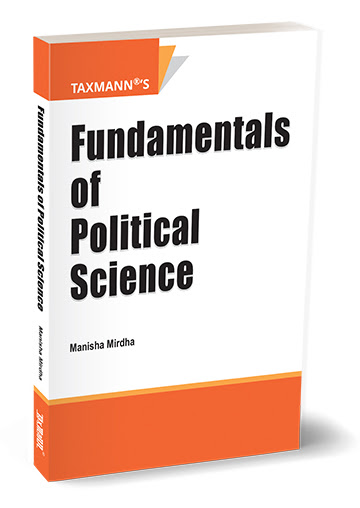
Fundamentals of Political Science
Original price was: ₹475.00.₹380.00Current price is: ₹380.00.
| Author : Manisha Mirdha | Language: English |
| Edition: Latest | Binding/Format: Paperback |
| Publishing Year: 2025 | Publisher: Taxmann Publications |
In stock
Fundamentals of Political Science is a full-spectrum, first-course text that connects core ideas of politics with institutions, behaviour, policy, and international order. It moves deliberately from the meaning, scope, and methods of political science to the state and key political concepts; then on to governance forms, elections and voting, international relations, and finally public administration and public policy. The result is a rigorous yet highly readable survey that balances India-specific structures with comparative and global developments, consistently linking theory to practice.
This book is intended for the following audience:
- Undergraduate & Postgraduate Students of Political Science, Law, Public Policy, and allied social sciences who need a conceptually sound, exam-ready foundation that connects ideas with institutions, courts, and policy processes
- Teachers & Researchers seeking a compact, structured map of the field with end-of-chapter summaries and curated references for extension reading
- Civil Services & Competitive-exam Aspirants who require clear treatments of sovereignty, liberty, equality, justice, rule of law, electoral behaviour, IR theories, and administration/policy models in one place
- Engaged Citizens & Professionals in governance/legal domains who want balanced India–world coverage and a practice-oriented approach
The Present Publication is the Latest Edition, authored by Dr Manisha Mirdha, with the following noteworthy features:
- [Comprehensive Spectrum] Covers political thought, the State, governance, comparative politics, international relations, public administration, and public policy
- [Balanced Pedagogy] Moves seamlessly from conceptual frameworks to practical illustrations
- [Interdisciplinary Lens] Draws connections between politics, law, economics, psychology, sociology, and history
- [Rigorous yet Accessible] Academic depth expressed in clear language for a wider readership
- [Contemporary Relevance] Includes globalisation, democracy, disarmament, diplomacy, international organisations, and India’s foreign policy
- [Exam & Research Friendly] Each chapter concludes with summaries and key takeaways for revision and critical reflection
- [Utility Across Curricula] Suitable as a first textbook for BA/LLB/BA-LLB/MA starters, and a refresher for advanced or cross-disciplinary readers (law, management, public policy)
The coverage of the book is as follows:
- Chapter 1 — Introduction to Political Science
- Meaning, nature/scope, interfaces with other social sciences, traditional & modern approaches, political socialisation/culture/participation
- Chapter 2 — The State
- Elements (Montevideo criteria), functions, nation vs. state, state–society & associations, origin theories (divine right, force, contract, evolutionary), political obligation, and recognition
- Chapter 3 — Political Concepts & Types of State
- Sovereignty; liberty (negative/positive); equality (opportunity vs. outcome; feminist/Marxist views); justice (legal/substantive/global); rights & obligations; citizenship; rule of law
- Chapter 4 — Governance
- Typologies: parliamentary vs. presidential; federal vs. unitary; separation of powers; multiculturalism; challenges to modern government; e-governance and trends
- Chapter 5 — Elections & Voting
- Electoral behaviour, machinery, MCC, gender and elections, psephology and its limits, reforms, and judiciary–election interface
- Chapter 6 — International Relations
- State system & globalisation; IR theories (realism, liberalism, Marxism, constructivism, feminism, game theory); power (hard/soft/smart); foreign policy/diplomacy; disarmament; UN & emerging issues
- Chapter 7 — Public Administration & Public Policy
- Evolution (classical to New Public Administration), policy process & models (systems, institutional, incremental, rational choice, group/elitist, game-theoretic), and public institutions in India
The structure of the book is as follows:
- Each chapter is broken into sub-sections with conceptual clarity, practical illustrations, and comparative insights
- Key summaries, examples, and explanatory notes help reinforce concepts
- Balanced treatment of Indian political structures and global political trends, making it equally relevant for national and international readers
- Designed to spark inquiry while being exam-ready for academic curriculam
| Dimensions | 16 × 6 × 25 cm |
|---|
You must be logged in to post a review.





Reviews
Clear filtersThere are no reviews yet.